

As client demands become more complex and deadlines more compressed, CPA firms are increasingly turning to business tax preparation outsourcing to stay competitive and scalable. From small businesses to large enterprises, preparing business tax returns requires specialized expertise, robust systems, and a focus on compliance. At the same time, firms must manage workload fluctuations and control costs.
Outsourcing the preparation of business tax returns provides a powerful solution for CPA firms that want to expand capacity, reduce operational strain, and enhance accuracy during peak seasons or throughout the year.
This article explains what business tax preparation outsourcing includes, its benefits, best practices, and how to choose the right outsourcing model for your firm.
What Is Business Tax Preparation Outsourcing?
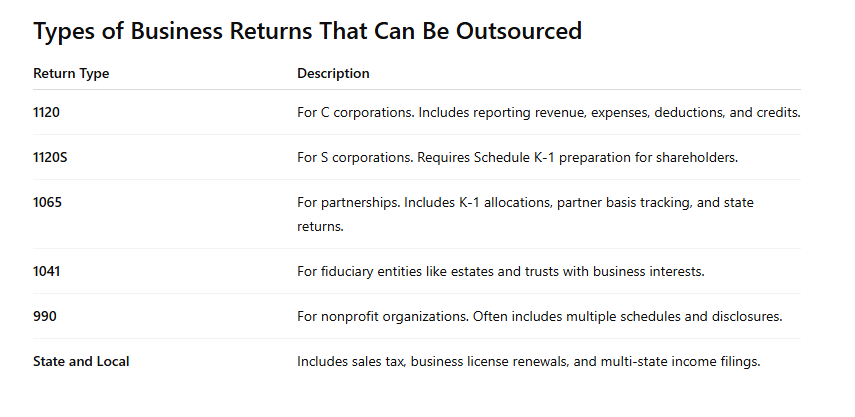
Business tax preparation outsourcing is the delegation of business tax return tasks to a third-party provider, either domestic or offshore. These providers specialize in preparing forms such as:
- Form 1120 – U.S. Corporation Income Tax Return
- Form 1120S – S Corporation Tax Return
- Form 1065 – Partnership Return of Income
- Form 1041 – Fiduciary Returns for estates and trusts
- Form 990 – For non-profit organizations
- Multi-state business returns and apportionment schedules
They support CPA firms by handling data entry, tax calculations, document preparation, e-filing assistance, and quality review, allowing firms to focus on more strategic client work.
Why CPA Firms Are Outsourcing Business Tax Preparation
- Manage Volume Without Adding Overhead
Business tax returns are typically more time-intensive than individual returns. Outsourcing allows firms to process larger volumes without increasing permanent headcount.
- Improve Turnaround Time for Business Clients
Deadlines for business returns often overlap with the individual filing season. Outsourcing reduces internal bottlenecks and helps firms deliver faster.
- Access to Specialized Business Tax Expertise
Outsourcing firms often employ professionals who are highly trained in business tax law, depreciation, state apportionment, and IRS compliance. This expertise reduces errors and supports more complex filings.
- Refocus In-House Staff on Strategy
When preparatory work is handled externally, internal staff can focus on advisory services like tax planning, entity restructuring, and client education.
- Get Year-Round Support
Many outsourcing partners now offer support beyond tax season. This includes quarterly filings, bookkeeping, estimated payment calculations, and other business tax-related services.
Key Benefits for CPA Firms
- Save 40 to 60 percent on labor costs
- Handle more clients without hiring full-time staff
- Maintain or improve accuracy with experienced tax professionals
- Deliver faster results during peak deadlines
- Improve profitability on flat-fee or bundled engagements
Choosing the Right Outsourcing Model
- Domestic Outsourcing
Best suited for firms that need close time zone alignment or prefer U.S.-based vendors. Suitable for regulated industries or government clients.
- Offshore Outsourcing
Cost-effective and scalable. Offshore firms now offer strong tax expertise, security protocols, and familiarity with U.S. tax software.
- Hybrid Approach
Combines the benefits of both. Firms can use onshore project managers with offshore preparers to balance cost and communication.
How to Evaluate an Outsourcing Partner
Choose a provider that meets the following criteria:
- Proven experience with business tax forms
- Proficiency in tax software like Lacerte, UltraTax, Drake, or ProConnect
- Qualified staff (CPA, EA, or CA)
- Fast turnaround times and clearly defined service levels
- Strong data security and compliance certifications (ISO, GDPR, etc.)
- Transparent workflow and revision process
- Willingness to offer a trial run or pilot project
Common Concerns and How to Address Them
Will I lose control of my client work?
No. Reputable outsourcing firms provide real-time dashboards and secure portals that give you complete visibility into each step of the workflow.
Is outsourcing business tax work secure?
Yes, when you work with firms that follow strict protocols. Look for SSL encryption, secure file transfers, NDAs, and compliance with IRS regulations.
Can I use outsourcing only during tax season?
Absolutely. Many providers offer flexible arrangements that let you scale up or down based on seasonal needs.
Best Practices for a Smooth Transition
- Start with a small batch of test returns
- Define your preferred formatting and review processes
- Use secure file-sharing tools and cloud-based tax software
- Set clear expectations for communication and revisions
- Document recurring client preferences for future consistency
Final Thoughts
Outsourcing business tax preparation is more than a seasonal fix. It is a strategic move that lets CPA firms stay agile, serve more business clients, and focus on high-value services. With the right partner, outsourcing can reduce costs, boost quality, and enhance client satisfaction.
Need help getting started with business tax outsourcing? Read our complete guide
Tax Preparation Outsourcing: A Scalable Solution for CPA Firms